MomentsInSG
· Technology · 3 min read
AI Everywhere Steady Pom Pi Pi or Just More Work.
This article explores the "ground-up" Singaporean perspective on AI, balancing high national adoption rates against workplace frustrations where employees often find themselves "babysitting" imperfect tools while preparing for a future of compulsory AI literacy.
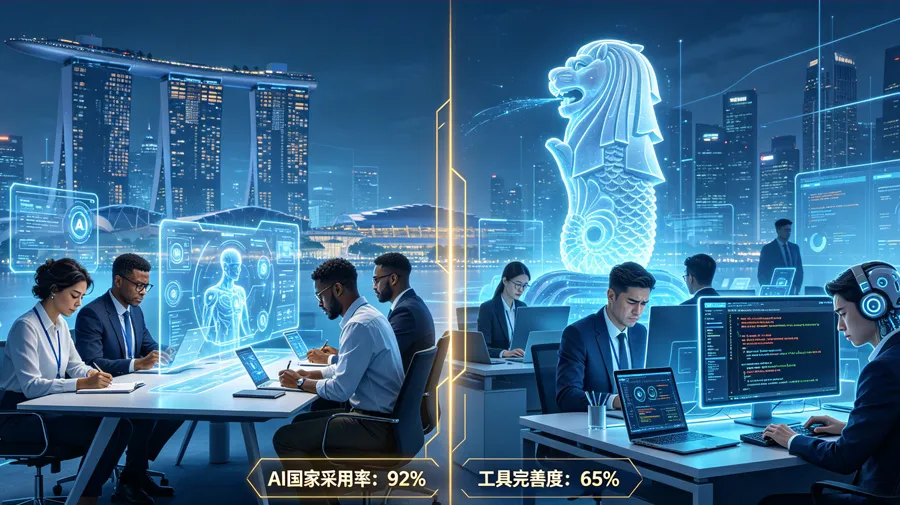
Now everywhere we go in Singapore, people are talking about AI. At the office, in the hawker centre, even at the void deck! According to some reports, our tiny red dot is actually ranked second in the world for AI diffusion, just behind the UAE. But for us normal people on the ground, the feeling is a bit “rojak”—a mix of excitement and “sian” (tiredness).
The Boss Say “Embrace AI,” But We Say “Babysit AI” 🙄
In the office, the bosses are always super “gan cheong” (anxious) about AI. They keep telling us to “embrace AI” every single meeting. But to be honest, many of us are not buying the hype. One worker even shared online that AI is “nowhere near as good as bosses think it is”. Half the time, the AI tool makes so many “blur” mistakes that we have to spend extra time manually checking and fixing its work. Instead of helping us pang kang (knock off) early, it feels like we are just “babysitting” a work-in-progress. While the “big shots” think AI is replacing jobs, some of us feel it just creates more work for the humans left behind.
Back to School for Everyone (No Choice Lah!) 🎒✍️
If you think AI is only for the tech geeks, you’re wrong already. From 2027 onwards, all university, poly, and ITE students must learn AI skills as part of their studies. The government wants us to be “AI-literate,” where we use AI as a “thinking and debating partner” to ask better questions, rather than just using it to cut corners. We want to “master and steer” the tools, not let the tools steer us. Even first-year ITE students now have to learn “prompt engineering”. The target is to have 100,000 “dual-talented” workers who know their own job AND AI.
AI with a “Local” Flavour (Finally Understands Singlish!) 🍛🗣️
What’s actually quite “steady” is that we are building AI that understands us—like the SEA-LION and MERaLiON models. These models are trained to understand Southeast Asian languages, including Singlish! This is important because global models sometimes don’t get our culture. Even Grab is using AI to help visually impaired riders by fine-tuning it to understand our local accents and pronunciations. It’s good to know that when I talk to a bot, it won’t just say “I don’t understand,” but might actually get my “lah” and “lor”.
The Future: Robot Butler or Just More Lag? 🤖🏠
Looking ahead, people are talking about humanoid robots like the ones from Tesla or Figure AI. But let’s be real—current robots still fail at 88% of household tasks. So, don’t expect a robot to help you mop the floor or dabao (take out) chicken rice perfectly anytime soon.
Also, the government is introducing a Model AI Governance Framework for Agentic AI to make sure these “agents” that can take actions on our behalf are safe. The key thing for the future is that humans must remain accountable. We don’t want “automation bias” where we over-trust the system until something goes wrong.
My Two Cents: AI is definitely improving fast, but it’s not magic. It can help us do maybe 30% of our work faster, but it cannot replace the “struggle of learning” and deep human thinking. We need to stay “kiasu” (competitive) by learning it, but also stay sharp enough to question it when it talks rubbish.